Monday, 1 January 2018

Reproduction of Art and Cultural Heritage.


Reproduction of Art and Cultural Heritage.

The arrival in my email in box of the following post on Enfilade has prompted me to put down a few random thoughts about the subject.


This is a subject close to my heart. The purpose of my blogs is to disseminate information, both written and visual about (mostly) English Portrait Sculpture and I want this information to be freely available to anyone who might be interested in the subject. In the main I have only encountered encouragement and enthusiasm from both private and institutional owners.

It seems to me that there are still  a few people within the museum world who see their holdings as their personal property - forgetting who paid for the objects and the reason for their existence in the first place.

If the purpose of Museums (which I believe) is to educate and enlighten, then it surely follows that images of their holdings should be freely available, (particularly where information on exhibits is limited and I find this is a real problem with many institutions) to those like myself who wish to add  to the knowledge of the subject and to inspire others to research further.

Very occasionally I have encountered brick walls when I have requested information or photographs.

No thanks are currently due to the Huntington Collection, who some time ago when I asked for photographs and information on their English portrait busts were unable to supply any - despite several requests.

I will try again! I have stated that I do not require professional studio photographs - those taken with a smart phone can serve my purpose - I prefer more candid photographs which give a much better indication of the sculptors original intentions.

The National Gallery of Victoria, Australia have a single beautiful photograph of the Rysbrack terracotta bust of Rubens on their website but were unwilling to provide any further good images for me, fortunately a member of staff did take some further digital photographs of it and sent them to me with strict instructions that they couldn't be published!

Despite paying the entrance fee at Westminster Abbey I was told in no uncertain terms that I could not take any photographs of the monuments and was referred to their library where (very poor) photographs are available for a large price.

These days most museums and galleries have very enlightened views regarding photography of their holdings but one or two still feel that they can monetise their collections.

The Rijksmuseum is particularly good in this respect and one can only hope that others will follow their lead.

It is not currently my intention to publish, in print any of the work on my blogs, although I have not ruled this out for the future.

Should I attempt this in the future the current cost of obtaining permissions from institutions such as Tate Britain would probably make any such project uneconomical.

Other works on my chosen subject have been severely hampered by the authors inability to locate and provide good photographs of their subject, The Marble Index by Malcolm Baker, published by Yale in 2014,  Published price £50 - now available on Amazon for about £40, comes to mind, where the majority of the photographs are old black and white library photographs. 


The estimable Bendor Grosvenor has covered this subject at some length on his blog Art History News - see these recent blog entries-


https://www.arthistorynews.com/articles/4950_Museum_image_fees__a_call_to_arms_ctd

https://www.arthistorynews.com/articles/4926_Image_fees__are_museums_guilty_of_misselling


see also

http://theartnewspaper.com/news/museums-right-to-charge-image-fees-is-called-into-question


In my blogs I have tried to credit all the information and photographs used and any omission is due to working in haste.

Certain websites do not allow one to "right click" in order to save an image -  but this is easily overcome using control print screen - I currently use a piece of Software called Faststone Capture not free but very easy and quick to use - see their website -

http://www.faststone.org/FSCaptureDetail.htm

This can be particularly useful for saving pages from online journals where there is limited availability - jstor comes to mind.

Whilst I am on the subject - it seems to me that print, either in book or journal form is an antediluvian method of providing information and it still surprises me that many authors see it as the sole means of delivering their product.

Blogging is very simple - it allows one to publish for very little or no cost and is most importantly interactive. It also allows for comments or criticisms to be made and for the reader to engage with the author.

Whilst I will never stop buying books I believe that it is about time that publishing caught up with modern digital technology - in my case it is simplicity itself for me, in my blog to provide many images of a three dimensional object, to provide a descriptive text and to link it to Museums, Libraries and other websites in order to provide maximum information at minimum cost.

Most of the modern non fiction books in my personal library have cost between £40 and £100 - putting them out of reach of most interested individuals. The inclusion of a CD with further information is always a bonus but it is still used infrequently.

I hope that my readers here will forgive my amateurism and look forward to any responses.

This blog acts as a sort of test bed, aide memoire and online filing system although it seems to have taken on something of a life of its own - interested parities might like to take a look at my other blogs

https://bathartandarchitecture.blogspot.co.uk/

https://wheelergateceiling.blogspot.co.uk/2016/11/introduction-wheelergate-ceiling.html

_________________________________________


Portrait of an Anonymous Sitter leaning against a Pedestal with a bust.

c. 1660 - 65.

Sir Peter Lely (1618 - 1680).

Oil on Canvas.

1245 x 1010 mm.

Hatchlands Park, Surrey.

National Trust.

Image Courtesy National Trust.

http://www.nationaltrustcollections.org.uk/object/1166160


Thursday, 21 December 2017

Man with bust by Lely


Sculpture in the Paintings of Sir Peter Lely.

some very brief notes -


Unknown Gentleman with Bust 
 Sir Peter Lely (1680 - 1680).
c. 1660 - 65.
at Hatchlands Park.
National Trust.

Continuing with the theme of occasional posts of 17th and 18th Century Sculpture depicted in other media.


Oil on canvas
1245 x 1010 mm.


It has only tentatively been suggested that the informality of the pose of the sitter could be an artist friend of Lely and therefore possibly Alexander Browne who was living at Long Acre, Covent Garden, London in the 1660s and was a teacher of Samuel Pepy's wife.

see -      http://www.nationaltrustcollections.org.uk/object/1166160


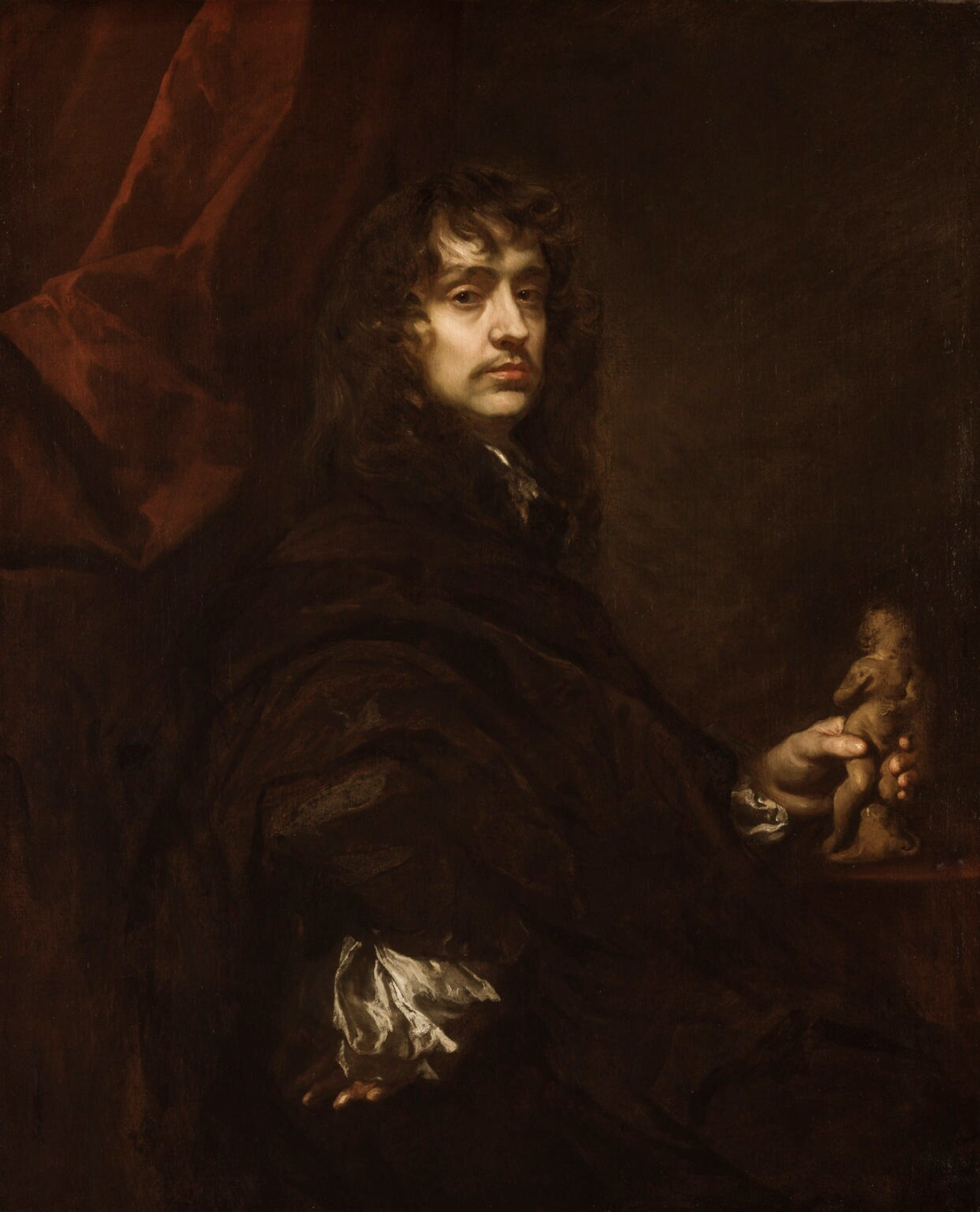
Peter Lely
Self Portrait with Statuette
1080 x 876 mm
Oil on Canvas
National Portrait Gallery

Lely succeeded Anthony van Dyck in 1661 as Principal Painter in Ordinary to the Charles II.
He was in turn followed by Godfrey Kneller in 1680

__________________________________________

Anna Marie Talbot, Countess of Shrewsbury. (1642 - 1702).
nee Anna Maria Brudenell
With Bust on Pedestal.
Peter Lely. 

Her husband was Francis Talbot, 11th Earl of Shrewsbury, who died after a duel fought with the Duke of Buckingham over her.


1270 x 1016 mm
Oil on Canvas c. 1665 - 70
Cliveden Estate, Buckinghamshire.

National Trust


http://www.nationaltrustcollections.org.uk/object/766110

_____________________________________


Excerpt from the Diary of Samuel Pepys.


Friday 17 January 1667/68

Up, and by coach to White Hall to attend the Council there, and here I met first by Mr. Castle the shipwright, whom I met there, and then from the whole house the discourse of the duell yesterday between the Duke of Buckingham, Holmes, and one Jenkins, on one side, and my Lord of Shrewsbury, Sir John Talbot, and one Bernard Howard, on the other side: and all about my Lady Shrewsbury, who is a whore, and is at this time, and hath for a great while been, a whore to the Duke of Buckingham. And so her husband challenged him, and they met yesterday in a close near Barne-Elmes, and there fought: and my Lord Shrewsbury is run through the body, from the right breast through the shoulder: and Sir John Talbot all along up one of his armes; and Jenkins killed upon the place, and the rest all, in a little measure, wounded. 

This will make the world think that the King hath good councillors about him, when the Duke of Buckingham, the greatest man about him, is a fellow of no more sobriety than to fight about a whore. And this may prove a very bad accident to the Duke of Buckingham, but that my Lady Castlemayne do rule all at this time as much as ever she did, and she will, it is believed, keep all matters well with the Duke of Buckingham: though this is a time that the King will be very backward, I suppose, to appear in such a business. And it is pretty to hear how the King had some notice of this challenge a week or two ago, and did give it to my Lord Generall to confine the Duke, or take security that he should not do any such thing as fight: and the Generall trusted to the King that he, sending for him, would do it, and the King trusted to the Generall; and so, between both, as everything else of the greatest moment do, do fall between two stools. 

The whole House full of nothing but the talk of this business; and it is said that my Lord Shrewsbury’s case is to be feared, that he may die too; and that may make it much the worse for the Duke of Buckingham: and I shall not be much sorry for it, that we may have some sober man come in his room to assist in the Government.

______________________________________


Portrait of Batholemew Beale with bust of Homer.
signed Peter Lely
c.1670
91.5 x 76.2 cms
Oil on Canvas
Dulwich Picture Gallery


https://www.dulwichpicturegallery.org.uk/explore-the-collection/651-700/bartholomew-beale/


As a child, Bartholomew Beale assisted his mother Mary Beale in her studio. It was expected that he too would become a painter. The bust upon which Bartholomew rests his hand in this portrait probably alludes to this. It appears to represent the ancient Greek poet, Homer. Blind and impoverished, Homer had long been considered the embodiment of artistic integrity, because he was true to his genius and did not seek to gain wealth from his art. As such, Homer would have acted as the perfect model for an aspiring young artist. Yet Bartholomew followed a different path and in 1680 entered Clare College, Cambridge to study medicine. In 1687, he settled in Coventry to practise as a physician until his untimely death in 1698.

Text here lifted from Dulwich Gallery website

_____________________


Self Portrait of Sir Peter Lely with architect Hugh May
Audley End House

Saturday, 16 December 2017

Le Sueur Bronze head of Henri de Montmorency


 Bronze head of Henri de Montmorency (1595 -1632)
from the Equestrian Statue formerly at the Chateau of Chantilly
destroyed in the French Revolution.

Possibly by Hubert Le Sueur.
Now in the Louvre, Paris.

Bought 1849 from collection of M. Signol.

Henry II Duke de Montmorency was executed for treason at Toulouse 30 October 1632.


Balthazar Moncornet (1600 - 68).

Engraving.

no size given


_____________________________________


Henry II, Duke de Montmorency.

Balthasar Moncornet.

engraving 153 x 112 mm.

1630 - 68.

British Museum.

________________________________


Perre Mariettte I.

1632.

Engraving.

198 x 133 mm.

British Museum.

_________________________________


Henry II, Duke de Montmorency.

Claude Mellan (1598 - 1688).

Engraving 18.3 x 12.7 cms.


_________________________________________________


The last three low resolution 17th Century engravings from French website


Friday, 1 December 2017

James II, Queen Anne and Queen Mary University College, Oxford.


The Statues of James II, Queen Anne and Queen Mary 
University College, Oxford.

Continuing with the theme of Portrait Statues and Busts at Oxford University I post this page as an aide memoire and hope to return to the subject once I have taken photographs of these statues.

Note to readers of this blog - I started it in order to file notes and pictures of subjects that I intend to return to in the future - it acts as a sort of on line filing system and test bed for ideas for essays on the subject of 17th and 18th Century Portrait Sculpture, although it seems to have taken on something of a life of it's own.

Currently my main blog is http://bathartandarchitecture.blogspot.co.uk/

I had originally intended to write on another of my enthusiasms - thus the name.

________________________

Much of the writings of Mrs Esdaile, particularly the earlier literature such as her Roubiliac monograph was prone to fanciful speculation  - we should nevertheless be grateful for her pioneering work, but this late essay on the University College, Oxford statue of James II is an extremely erudite and useful work. see -

http://oxoniensia.org/volumes/1951/esdaile.pdf

___________________________


The University College statue of James II, erected in ,1686,'7, shows him,as in the case of three of his other statues, in Roman dress. Beyond the fact that it came from a London yard, the College paying carriage,' nothing is known of its authorship.

There was an inscription below the statue: 'J. Ward Merc. Lond.'

'For bringing down from London & Setting up his Majtys Statue (K. James ye 2d)' £14. 14s. 11d. (Bursar's Account, 1686, from Smith's Transcripts, ix, 261).


Loggan's engraving gives an accurate picture of the college at this date. Oxonia Illustrata was published in 1675, so that his drawing was actually made before the east side of the quadrangle was finished. The niches on the gate tower and over the doorways to hall and chapel are all shown empty. The first to be filled was the niche over the outer arch of the tower. A statue of King Alfred, the gift of Dr. Robert Plot, the historian of Oxfordshire, was set up here on 17 Jan. 1683, on his becoming a fellow commoner. (fn. 154) In Oct. 1686 it was removed to the niche over the doorway leading to the hall (fn. 155) and at the same time the companion niche over the chapel doorway was filled by a statue of St. Cuthbert, procured by Obadiah Walker 'at his own or some other Roman Catholick's Expence'. (fn. 156) The two statues seem to have been removed when the south side of the quadrangle was altered in 1802. The remains of King Alfred for long lay in the rockery in the Master's garden.

Obadiah Walker was also responsible for the statue of James II over the inner arch of the tower. Wood gives a description of 'the great ceremony' when it was set up on 7 Feb. 1687, the day following the anniversary of the king's accession, which fell on a Sunday that year. (fn. 157) It was the gift of a Roman Catholic, (fn. 158) but the college had to pay the bill for the carriage and erection of it. (fn. 159) Describing King James's visit to the college later, Smith relates how His Majesty was taken into the chapel by Walker to view the painted windows so that he 'could not but see his own Statue in coming out of it'. Like the bronze statue by Grinling Gibbons in St. James's Park, the king is represented in Roman armour and wearing a toga. These are the only two extant statues of James II.

The place of King Alfred over the entrance facing the street was taken by a statue of Queen Anne, the gift of John Ward, brother of George Ward, fellow. This was erected on 4 Oct. 1709. It was commonly regarded as an astute piece of flattery on the part of the Master, Dr. Charlett, about whom the following verse was composed:


O Arthur, O in vain thou tryes
By merit of this statue for to rise;
Thou'lt nere an exaltation have
But that on Prickett's shoulders to the grave.
Prickett, 'the pragmaticall butler of the College', was Dr. Charlett's powerful ally in all internal affairs

Text above from British History online


see also - https://www.univ.ox.ac.uk/content/anne-and-mary-two-queens-univ


Mrs Esdaile suggests John Bushnell as the author


See The University College Statue of James II
By The Late KA Esdaile and MR Toynbee
from Oxoninsia 1951

http://oxoniensia.org/volumes/1951/esdaile.pdf

________________________

For anyone interested in Oxford this is an absolutely invaluable source.

http://oxoniensia.org/oxo_toc.php


_______________________________


ANNA REGINA | ... merc. lon. | mdccix | p - Queen Anne (London 1665 - London 1714), Queen of England, Scotland and Ireland, since 1702; and from 1707 Queen of Great Britain and Ireland until her death 

Image from - http://statues.vanderkrogt.net/object.php?webpage=ST&record=gbse147


MARIA 2da REGINA | E degatis Dris radcliffe | MDCCXIX - Queen Mary II (London 1662 - London 1694), joint Sovereign of England, Scotland, and Ireland with her husband (who was also her first cousin), William III and II, from 1689 until her death.


From the Minute Book and Account Book of the Radcliffe Trustees we learn that the statue of Queen Mary was copied from one at Richmond and that Nost (John van Ost) was paid £40 for it. Dr. Radcliffe's statue is by Francis Bird, who charged £70. from British History Online


Image from - http://statues.vanderkrogt.net/object.php?webpage=ST&record=gbse147


For University College, Oxford - British History on line see - 

http://www.british-history.ac.uk/vch/oxon/vol3/pp61-81


See also - https://www.univ.ox.ac.uk/content/anne-and-mary-two-queens-univ


 Anne (1702–14) and Mary II (1689–94) - these statues look over the High from the Main and Radcliffe Quadrangles respectively. Mary II never visited Univ, but her future husband William III had visited in December 1670. On the other hand, Anne did visit Univ in May 1683 with her father the Duke of York (later James II) when she was still a princess.
Created ten years apart, in 1709 and 1719, these statues tell us much about the politics of the period, and in particular the activities of Arthur Charlett, who was our Master from 1692–1722, and a great networker and intriguer in Oxford.
The statue of Queen Anne was erected over the entrance to the Main Quad in October 1709. Like the statue of her father inside the quadrangle, it was a gift to the College, in this case by the brother of one of our then Fellows, George Ward. We do not appear to have a record of the sculptor who created it.

The choice of subject might seem simple enough: Anne was the reigning monarch at the time. However, several contemporaries suspected that Charlett was eager to accept the gift so that he could make a public declaration of his loyalty to the queen, and perhaps receive some preferment as a result. That was certainly the reaction of the diarist Thomas Hearne. Hearne lived across the road, in St. Edmund Hall, and had friends in Univ who passed on the latest gossip on to him. So, in his entry for 4 October 1709, Hearne wrote:
“Most of the Fellows were for placing the said Statue in the Inside of the College by King James’s; but Arthur Charlett out of his vain Glory would have it without side that he might the more be taken of.


University College, Oxford
Engraved by David Loggan
1675


Image courtesy Welcome Library website

see - http://catalogue.wellcomelibrary.org/record=b1178699


Tuesday, 28 November 2017

Busts of Sir William Fermor and his wife Mary attributed to Peter Besnier


Sir William Fermor (1621 - 1661) and his wife Mary (d. 1670). 
of Easton Neston

A Pair of Plaster Busts.

Attributed to Peter Besnier (d. 1693).

Part 2 of a brief look at the works of the Besnier family .


Sold at Sotheby's Easton Neston sale Lot 12 - 17th May 2005.


Bought with the aid of an Art Fund grant by Northampton Museum and Art Gallery.

Entry below from The Biographical Dictionary of Sculptors available online at -


Peter Besnier (Bennier) - A French sculptor and the brother of Isaac Besnier, who had collaborated with Hubert le Sueur on the monument to George Villiers, 1st Duke of Buckingham, erected in Westminster Abbey in 1634. Peter Bennier may have been trained in France but was living in England before October 1643, when he was appointed sculptor to King Charles I. He was required to look after the ‘Moulds, Statues and Modells’ in the Royal collection, a duty previously performed by his brother, in return for the use of a house and £50 pa from the privy purse. 

The Civil War prevented him from taking up his duties and he was deprived of his office during the Commonwealth. At the Restoration he petitioned to be reinstated on the grounds that the late King had granted him the ‘place of sculptor to His Majesty and the custody of his statues, etc, but by reason of the most unhappy distraction befallen since, hee injoyed not the same place, but was reduced into very great poverty and want through his faithfulness and constancy’ (TNA SP 29/2, no 66-1, quotedby Faber 1926, 14). His request was granted on 15 March 1661 (TNA, LC3/25, 113, cited by Gibson 1997 (1), 163) and he held the post until his death, when he was succeeded by Caius Gabriel Cibber.


Bennier is listed as a ratepayer of Covent Garden, 1649-51, and among the Ashburnham Papers is a reference to a tenement occupied by Bennier near Common Street in 1664 (LMA, ACC/0524/045,046,047, 048, cited by Gibson 1997 (1), 163).

 It has been tentatively suggested that he worked for Hubert le Sueur. He signed the monument with a ‘noble’ portrait-bust to Sir Richard Shuckburgh (1) (Gunnis 1968, 50). 


The monument to Sir Hatton Fermor at Easton Neston, Northants, has been attributed to him because the bust is similar to the Shuckburgh one and the two families had intermarried. 

In 1655 Bennier was employed at Lamport Hall, Northants, carving shields and ‘pictures’, which were probably statues (Northants RO, IL 3956, cited by White 1999, 11, 12 n 10-11) (2). He also did unspecified work for the crown at Somerset House in 1661-2.

Literary References: Gunnis 1968, 50; Colvin V, 1973-6, 255; Whinney 1988, 90, 93, 439 n 16, n 21, 440 n 2-3; McEvansoneya 1993, 532-5; Grove 3, 1996, 875 (Physick); White 1999, 11-12


Attention should be paid to the form of the socles - variations of which appear on English and Netherlands busts of the 17th century.

Photograph Courtesy Sotheby's.

see - http://www.sothebys.com/en/auctions/ecatalogue/lot.12.html/2005/sale-at-easton-neston-l05500


The Sotheby's Catalogue entry for these busts follows below -

A pair of plaster busts of Sir William Fermor, 1st bt. (1621-1661) and his wife Mary (1628-1670), daughter of Hugh Perry, attributed to Peter Besnier (French, d.1693),
1658.

He wearing quirass with lions pauldrons and a sash tied on his right shoulder, his hair falling in locks over the breastplate, an old illegible paper label to the reverse; she facing slightly to dexter, her hair styled in deep curls about her bare upper chest and shoulders; each set on integral plaster socles bearing the date 1658. 


he 72cm., 28½in.; she 65.5cm., 25¾in.

These plaster busts are notable survivals of 17th century English portrait sculpture and represent important additions to the small corpus of known works executed by the French-born artist Peter Besnier, Sculptor-in-Ordinary to Charles I and later Charles II. They have never been previously published.

The attribution rests on physiognomic and stylistic comparisons as well as contextual evidence. The expressive modelling of the heads with their animated features are more advanced than the work of Besnier’s predecessor as Court Sculptor, Hubert Le Sueur, whose portraiture has been rightly criticised for having a ‘curiously inflated appearance’. The angle of the heads are more accentuated than the iconic frontality found in Le Sueur’s busts. In their sense of movement they are much less mannered and the richly modelled sash, drapery and hair - notably to the bust of Mary - imbue them with a liveliness derived from the Italian Baroque. 


In this connection one might at first think of two other sculptors active in Caroline England, namely the Italian, Francesco Fanelli (1577-after 1641) and the Fleming, Francois Dieussart (c.1600-1661). Whinney, who was the first to raise the possibility that Besnier may have been the sculptor responsible for the Easton Neston busts, observed that they were ‘closer to the style of Dieussart’ (op.cit. p.440, note 2). There is no specific comparison to be made in support this hypothesis, unless Whinney was alluding to their advanced baroque naturalism: Dieussart was perhaps the most talented of the foreign sculptors lured to London having spent the years 1622-1630 in Rome assimilating the latest developments in Baroque sculpture. 

However Dieussart had departed for The Hague in 1641, well before the Easton Neston busts could have been modelled, and the same year also marks the last recorded reference to Fanelli in England. 

It is Peter Besnier’s elder brother Isaac (active 1631-c.1642) who therefore provides the point of departure for a meaningful stylistic comparison, and one that can be seen to reinforce Whinney’s initial, if instinctive, placement of the busts in the Besnier orbit.

Isaac Besnier was first employed to look after the ‘Moulds, Statues and Modells’ in the royal collection but his major sculptural contribution is to be found in the realm of monumental tomb sculpture of the 1630’s. He collaborated with Le Sueur on the tombs of three of the greatest personalities of the Caroline Court: that of the Earl of Portland in Winchester Cathedral; and those of the Duke of Buckingham and the Duke of Richmond and Lennox in Westiminster Abbey. While Le Sueur cast the figures and effigies in bronze, Isaac carved the architectural marble components, including the statuary and tablets. Indeed Lightbown credits him for a significant part of their overall design.  It is interesting to hypothesise how the commission for the busts came about. Each portrait bears the date 1658, an inauspicious time for sculptor and patron alike.
Sir William Fermor was the elder son of Sir Hatton Fermor and his wife Anne Cockayne.  At the outbreak of the Civil War he and his younger brother Hatton joined the King.  William was created a baronet by King Charles 1641: his younger brother was less fortunate dying for the Royalist cause at Culham Bridge in 1645.  Sir Williams's marriage was very much a reflection of his loyalties.  His wife Mary Perry was the widow of the Hon. Henry Noel who had died a prisoner of the Parliamentarians. His brother Baptist Viscourt Campden was a colonel in the Royal Horse Regiment.
During the years of the Interregnum Sir William had had to compound for his estate and was under constant suspicion of agitation. In 1653 he was summoned before the council and in 1655 he was accused of killing the Protector’s deer. In 1658, the year of his portrayal, he was publicly listed as a Northamptonshire royalist without military rank. Besnier too suffered hardship, having been deprived of his office of court sculptor, which he had held since 1643, by the Parliamentarians. In his petition for reinstatement at the Restoration, he claimed that he had fallen into ‘very great poverty and want’ (see White op.cit.). However the evidence suggests the opposite was true. In 1655 he was carving statues and shields for John Webb’s revisions to Lamport Hall, Northamptonshire (not far from Easton Neston) and in the following year, 1656, he was working on his only signed and securely attributed work, the monument to Sir Richard Shuckburgh, just across the border in Warwickshire. These commissions, together with the present plaster busts, perhaps intended as presentation models for finished bronzes, show that Besnier was not as close to the ‘great poverty’ he claimed to be. If it was not his work at Lamport that brought him to the attention of Sir William, it must have been owing to the Shuckburgh monument that artist and patron became acquainted. Sir William’s sister Katharine was married to Sir John Shuckburgh, Sir Richard’s son and heir (see White op.cit., p.12), which provides a convenient avenue for their introduction.

Whinney, followed by White, attributes the posthumous monument to Sir Hatton and Lady Fermor in St. Mary’s Church, Easton Neston, to Peter Besnier. The memorial also commemorates Sir William, whose marble bust appears between the two figures of his parents. This bust bears no relation to the present plaster and is of a much inferior standard of execution. The general design of the monument, with its three effigies of Sir Hatton’s daughters arranged at the very top, recall his brother Isaac’s work of the 1630’s for the Earl of Portland. The tablet inscription nonetheless dates it to 1662, a year after Sir William’s death and at a time when Peter Besnier is documented in London working in his court capacity at Old Somerset House.


_____________________________________


Whinney notes that the only signed monument by Peter Besnier - the monument to Sir Richard Shuckburgh d. 1656 at Shuckburgh, Warwickshire is similar in style to the Fermor monument at St Mary's Church Easton Neston, Northamptonshire (see below) - the two families were related by marriage.

I have not yet been able to locate a good photographs of either of these monuments.

The paragraph below from British History online from - A History of the County of Warwick: Volume 6, Knightlow Hundred. Originally published by Victoria County History, London, 1951.

The south chapel (12 ft. 6 in. by 9 ft. 2 in.) is similar to the one on the north. Against the east wall is a large marble memorial to Richard Shuckburgh, died 1656. It has a classic pediment with the Shuckburgh coat in the tympanum, surmounted by three urns, and below a portrait bust flanked by angels with trumpets holding back curtains. Underneath there is a carved panel with inscription, under a pediment of scrolls with a skull on either side. It rests on a carved splay and a moulded base, with a block in the centre of the moulding on which is placed a skull, below it the name Pet. Bennier.


Sir William Fermor purchased some of the Arundel Marbles - those not in the Ashmolean.

Guelphi was employed in the 1720's to restore (or some might say mutilate) them.
___________________________


The Monument to Sir Hatton and Lady Fermor at St Mary's Easton Neston is attributed to Peter Besnier

St Marys Church
Easton Neston
Towcester
Northamptonshire
NN12 7HS


Telephone: 01327 350459 Email: office@tovebenefice.co.uk Access through Easton Neston Park via Hulcote

The church is normally locked. Access is through The Towcester Benefice Office 01327 350459

________________________________________