Wednesday, 3 August 2016

Equestrian Statue of Prince Frederick by John Cheere, Hartwell House.


Equestrian Statue of Prince Frederick Louis (1707 - 57), Prince of Wales.
Dressed in Roman Armour.

Hartwell House, Buckinghamshire.

by John Cheere.
 
Erected in 1757.

Some notes - I intend to return to the subject of this and the other comparable 18th century English equestrian statues in the future.
 
The right hand proper foreleg is very ungainly - the lead appears to have sagged - it is my guess that the iron armature within the leg has failed.
 
Hartwell was home of the Whig Sir Thomas Lee The family were prominent supporters of the Prince.
His brother Dr George Lee was adviser to the prince after the Excise Bill crisis of 1733 another brother was Sir William Lee was Lord Chief Justice.
 
Hartwell is currently leased to the National Trust and operates as a country house hotel.
 

For the context of Prince Frederick and the Lees and the gardens at Hartwell see -
 Prince Frederick and Liberty: The Gardens of Hartwell House, Buckinghamshire, in the Mid-Eighteenth Century by Richard Wheeler Garden History  - Vol. 34, No. 1 (Summer, 2006), pp. 80-91. Journal of the Garden History Society. 
 
The quality of this statue begs the question - was it created by Cheere or was it modelled by another sculptor and cast by Cheere? 

It is my suspicion that neither John Cheere or his brother Henry were actually involved in the actual  sculpting but employed men in their workshops or subcontracted the labour.

I believe that amongst others Louis Francois Roubiliac was working with Both men in the 1730's / 40's.

This is a subject that requires much further in depth investigation and which I will return to in future posts.


............................


Frederick Louis, Prince of Wales.

Peter Scheemakers (1691 - 1781).

c.1737.
 
Prince Frederick shown here approximately 20 years younger.
 
The Bust is in the Royal Collection St Georges Hall, Windsor Castle.

Commissioned by Richard Temple, Viscount Cobham for the Temple of Friendship in the garden at Stowe, Buckinghamshire; by descent to 2nd Duke of Buckinghamshire; sold Christie's, 15 August 1848; bought Rainey; fifth Earl Temple; by whom sold Sotheby's, London, 9 May 1941; bought by HM Queen Elizabeth.
 
Royal Collection Trust / © HM Queen Elizabeth II, 2015.


______________________________________


Wax Relief.
Isaac Gosset (1713 - 99).
c.1750.
14.4 x 12 cms.

This oval ivory-coloured wax head and shoulders portrait depicts Frederick, Prince of Wales, oldest son of George II. He is shown in profile facing left and wearing armour and the ribbon of the Order of the Garter. It is set on sanded cavetto moulded gilt ground with an oval ebonised wood frame. Vertue described the skill of the ‘Ingenious Isaac Gosset’ as ‘so universally approved on for likeness’ that he dedicated a section in his notebooks to wax carving, which he considered a growing industry. 

Gosset was from a Huguenot family which had fled to Jersey after the Revocation of the Edict of Nantes. The family later moved to London and Isaac learned wax modelling and frame carving from his uncle Matthew. His wax production was prolific and covered both classical and contemporary figures. Gosset’s renown lay in the fact that, unlike most contemporary wax modellers, he worked from life, and at speed, apparently producing a portrait in under an hour. Gosset also created a secret recipe for tinting his wax to appear like old ivory. His waxes were highly fashionable and were sold at four guineas a piece for an original portrait or one guinea for a copy. 

Vertue noted that Gosset ‘had the honour of the King sitting to him’ as well as ‘great numbers of persons of Quality and persons of distinction – Learned and others’. 

Queen Caroline is known to have commissioned various works from Gosset, and may even have granted him a pension. The Picture Closet at Kensington displayed numerous waxes, framed both singly and in groups of up to 16 figures. 

Some Vertue catalogued as historic and contemporary princes but most remained unidentified. 

Text  here adapted from The First Georgians; Art and Monarchy 1714 - 1760, London, 2014.

Provenance
Possibly from the collection of George III. Presented to the Royal Library by Queen Mary in 1932. Possibly ex-Messrs. Law, Foulsham and Cole, London.
 
 
Image and text - Royal Collection Trust / © HM Queen Elizabeth II, 2015.


Prince Frederick Louis.

wax  - 14.8 x 12.1 cms overall.

C. 1750.
by Isaac Gosset.

Ex-Duke of Newscastle collection, no. 381. Purchased by Queen Mary at the Duke of Newcastle's collection sale, Christie's, 8th June 1937, Lot 24 'set of 6 (six) Gossett Portraits of George II, George III, Frederick Prince of Wales, George Prince of Wales, Duke of Cumberland and Duke of Brunswick' at £30.
Royal Collection Trust / © HM Queen Elizabeth II, 2015.


__________________________________
 
Here would seem as good a place as any on this blog to place some of the later portraits of Prince Frederick Louis.
 
A portrait bust simulating a statue in a niche, of Frederick, wearing a sash; cut from the tenth plate of a series of ten, each of four royal portraits.  1731  Mezzotint

John Faber the Younger.

1731.
Mezzotint.

176 x 124 mm.

British Museum.
 
_______________________________


John Faber Jnr (1684 - 1756) at the Green Door in Craven Buildings Drury Lane.

After the original by Jeremiah Davison (1695 - 1750).
 
Mezzotint.

35.2 x 25 cms platemark.

c . 1730 - 39.
 
 
Royal Collection Trust / © HM Queen Elizabeth II, 2015.
 
_____________________
 
 
Frederick Prince of Wales.

Mezzotint.

John Faber Jnr at the Golden Head Bloomsbury.

after Thomas Hudson.

32.6 x 22.6 cms platemark.

Dated 1751.
____________________________


 Mezzotint,

 British Museum.


............................


Prince Frederick Louis.

van Loo.

c 1742.

with dealer Philip Mould.


Tuesday, 2 August 2016

Equestrian Statue of William III, Petersfield.


Lead Equestrian Statue of William III.
In Roman Armour.
Circa 1750.
by John Cheere.
Formerly Gilded. 
Petersfield, Hampshire


William III, Petersfield
 
 
In 1734 John Jolliffe nominated as M.P. his uncle Sir William, Jolliffe, who served until 1741 with Edward Gibbon II. John Jolliffe served as M.P. 1741, 54 and 1761 to 68. After 1761 there followed a long period when a member of the Jolliffe family represented the Borough of Petersfield until 1866, except 1835 - 41, when  John Hector Cornthwaite served. Sir William Jolliffe strongly supported the Protestant succession, symbolised by William III.
After the 1745 Jacobite troubles, he wished the Jolliffe family to be visibly aligned with Protestantism.

Sir William Jolliffe died in 1749 and, in his will, left his three nephews £500 in order to erect an equestrian statue to William III in the Borough.
The statue by John Cheere was erected first in the circus at the entrance to Petersfield House demolished in 1793 (which today is the centre of the road by the Police Station). 

The statue was moved to its present position in the town centre in 1812.
Mr. John Jolliffe built Petersfield House in the Lawn where was previously the residence of his father-in-law, Mr. Robert Michell. It was a fine red-brick mansion with stone facings of the style of Queen Anne. It occupied the site of the schools and the police-station between St. Peter's Road and Hylton Road, and traces of artificial canals can still be seen. When the house was pulled down in 1793, due to parish disputes, the entrance gates of Sussex iron were removed to Merstham House, Redhill, where they are at the present day.
 
For the Royal Equestrian Statues see - Reading the Royal Monument in Eighteenth Century Europe by Charlotte Chasel Rousseau, 2011.


Monday, 1 August 2016

Equestrian Statue of George I, Hackwood Park.


The Equestrian Statue of George I,
Wearing Roman Armour.
Lead.
Hackwood Park.
by John van Nost II.
 
 
1722. Possibly a gift from the King to the third Duke of Bolton.


Hackwood from Ackermann’s Repository of Arts, Literature, Fashions and Manufacture etc 
in September 1825.


British Museum


Equestrian Statue of George I formerly in Leicester Square

 
The Equestrian Statue of George I.
Lead.
Wearing Modern Armour and Holding a Baton.
 
From Canons
Formerly in the garden of Leicester Square.
Cast by John van Nost II.
Set up in 1747.


Statue of King George I, Leicester Square, London; photograph taken in 1866.


The Country Journal of Craftsmen, under the date of April 16, 1737, contains the following statement:—"Leicester field is going to be fitted up in a very elegant manner: a new wall and rails to be erected all round, and a basin in the middle, after the manner of Lincoln's Inn Fields."
 
Northouck, in 1773, writes:—"This is a handsome square, the inner part of which is enclosed by iron rails, and adorned with grass plats and gravel walks. In the centre is an equestrian statue of his present Majesty, gilt." This statue was really of George I., modelled by C. Buchard for the Duke of Chandos, and brought from Canons in 1747, when it was purchased by the inhabitants of the square. It was finely gilt, and in 1812 was re-gilt.
 
For an interesting discussion on the origins of the statue see - 
NOTES AND QUERIES: MEDIUM OF INTER-COMMUNICATION FOR LITERARY MEN, ARTISTS, ANTIQUARIES, GENEALOGISTS, ETC. 1862 page 151.
_________________________________
 
Old and New London: Volume 3. Originally published by Cassell, Petter & Galpin, London, 1878.
On the removal of Wyld's "Great Globe," after occupying the square for about ten years, the enclosure became exposed once more in all its hideous nakedness. From that time down to the middle of the year 1874, its condition was simply a disgrace to the metropolis. Overgrown with rank and fetid vegetation, it was a public nuisance, both in an æsthetic and in a sanitary point of view; covered with the débris of tin pots and kettles, cast-off shoes, old clothes, and dead cats and dogs, it was an eye-sore to every one forced to pass by it.
 
As for the "golden horse and its rider," the effigy of George I., which had been set up in the centre of the enclosure when Leicester House was the "pouting place of princes," besides having suffered all the inclemencies of the weather for years, it had become the subject of every species of practical joke by almost every gamin in London.
The horse is said to have been modelled after that of Le Sœur at Charing Cross; whilst the statue of George I. was considered a great work of art in its day, and was one of the sights of London, until after a quarter of a century of humiliations, after being the standing butt of ribald caricaturists, and the easy mark of witlings, it gradually fell to pieces.
The effigy of his Majesty was the first to be assailed. His arms were first cut off; then his legs followed suit, and afterwards his head; when the iconoclasts, who had doomed him to destruction, at last dismounted him, propping up the mutilated torso against the remains of the once caracolling charger on which the statue had been mounted, and which was in nearly quite as dilapidated a plight.
 
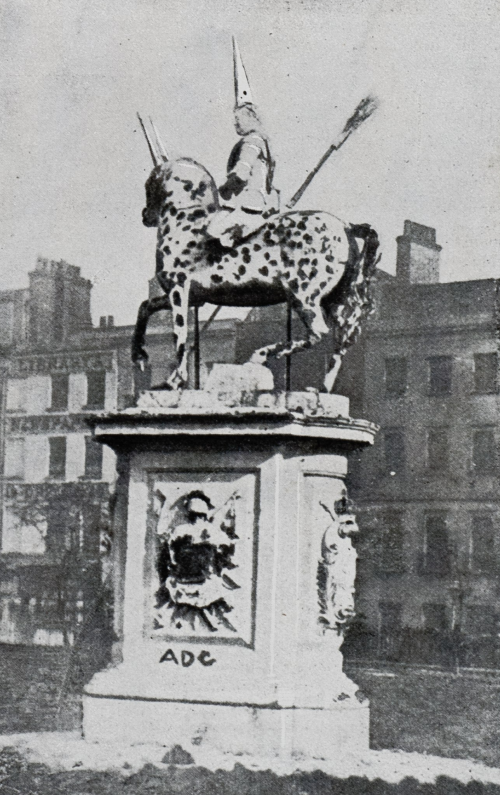
It would be almost impossible to tell all the pranks that were played upon this ill-starred monument, and how Punch and his comic contemporaries made fun of it, whilst the more serious organs waxed indignant as they dilated on the unmerited insults to which it was subjected. One night a party of jovial spirits actually whitewashed it all over, and daubed it ignominiously with large black spots.
The defaced John Nost II statue of King George I in Leicester Square, London, 1866


Leicester Square, London.
 
 
The Leicester Square Sensation; from Fun, 27 October 1866.
 
From Fun, 27th October 1866.
 
________________________________________
 
The fire at Savile House, Leicester Square, London; from The Illustrated London News, 11 March 1865.
from Illustrated London News 11 March 1865.
 
_____________________________
 
 
Hints for the improvement of Leicester Square by the artist who whitewashed the statue; from Punch, 29 September 1866.
 
 
Illustration from Punch 29 September 1866.
 
____________________________
 
 
The Leicester Square, London, statue 17 October 1866.
 
Anon. Engraving.
 
17 October 1866. 
 
The statue in Leicester Square; dated 17 October 1866.


A Sketch in Leicester-Square. Illustration for The Illustrated London News, 11 January 1868.
 
Illustrated London News - 11 January 1868.
 
____________________________
 
 
A Scene in Leicester-Square. Illustration for The Illustrated London News, 10 February 1872.
 
Illustrated London News 10 February 1872.
 
The Last of the Old Horse, in Leicester Square, London; from the picture by J O'Connor in the Royal Academy, 1874. Published in Leicester Square; its associations and its worthies. By Tom Taylor; published by Bickers and Son, 1 Leicester Square, London, 1874.
 
The Last of the Old Horse, in Leicester Square, London; from the picture by J O'Connor in the Royal Academy, 1874. Published in Leicester Square; its associations and its worthies. By Tom Taylor; published by Bickers and Son, 1 Leicester Square, London, 1874.
 
All the above images lifted from


George II Golden Square, Soho. by John van Nost II and a Marble Statue at Greenwich by Michael Rysbrack

 
The Lead Statue of George II,
Golden Square, Soho. London.
by John van Nost II.
 
Re erected in Golden Square in 1753.
 
Made originally for Canons House, for the Duke of Chandos in 1720.


Having removed the existing forearm/hand
 
_________________________________
 
 
The Marble Statue of George II
Michael Rysbrack 
1735
Greenwich.
 
The statue is marble 220cms tall, the pedestal is of Portland Stone 220 cms tall.
 
For an entry in my parallel blog with further information and photographs of the portrait sculpture of George II  see -
 
    Governor Admiral Sir John Jennings, Prefect of the Hospital, agreed to pay for a statue, if governing body provided marble, to attract patrons for the ailing Naval Hospital. A block for a statue of Louis XIV was siezed from a French ship and purchased by the Hospital with the intention of executing statues of William and Mary according to Wren's plans for the River Gate.
 
The statue was placed in the Great Court on 1 March 1735 and ceremonially unveiled on 1 August when the Court was illuminated in celebration of the Queen's birthday.
. The face and most of the statue are severely worn due to Sandhurst cadets stealing into the then Royal Naval College in the 1950s to paint the statue with black stripes; the fluid used for their removal ate through the stone's protective coating.


   In the Old Royal Naval College Grand Square Greenwich.
 
GeorgoSecundo.jpg
 
{On the south face of plinth:}

PRINCIPI POTENTISSIMO
GEORGIO SECUNDO
BRITANNIARUM REGI
CUJUS AUSPICIIS ET PATROCINIO
AUGUSTISSIMUM HOC HOSPITIUM
AD SUBLEVANDOS MILITANTIUM IN CLASSE EMERITORIUM
LABORES A REGIS IPSIUS ANTECESSORIBUS FUNDATUM
AUCTIUS IN DIES ET SPLENDIDIUS EX(S)URGIT
JOHANNES JENNINGS EQUES
EJUSDEM HOSPITII PRAEFECTUS
ICONEM HANC PRO DEBITA SUA
ERGA PRINCIPEM REVERENTIA
ET PATRIAM CHARITATE
POSUIT
ANNO DOMINI
MDCCXXXV

{“To the almighty emperor, King George II of Britain, under whose direction and patronage this magnificent hospital, established by the king’s own predecessors to alleviate the burdens of retired seamen, is rising up, expanding and becoming more splendid every day.  Sir John Jennings, governor of the same establishment, placed this image in due reverence for the King and for the love of his country in the year of our Lord 1735.”}
{On the east face of plinth:}
HIC REQUIES SENECTAE
HIS MODUS LASSO MARIS ET VIARUM
MILITIAEQ(UE)
{“Here is a rest for old age, an end for someone who is tired of sailing the seas and fighting.”  From Horace’s Odes (Book 2 Part 6).}
{On the plinth, north (river) face:}
HIC AMES DICI PATER ATQ(UE) PRINCEPS
{“Here may you delight in being called our father and prince” From Horace’s Odes (Book 1 Part 2) and was originally addressed to Emperor Augustus.}
{relief carving of the Royal Standard 1714-1801}
 IMPERIUM PELAGI
{“The dominion of the sea”}
{On the west face of plinth:}
FESSOS TUTO PLACIDISSIMA PORTU ACCIPIT

{“This most peaceful place welcomes those who are weary to its safe haven.”  From Virgil’s Aeneid (Book 3 Chapter 4).}
_______________________________________


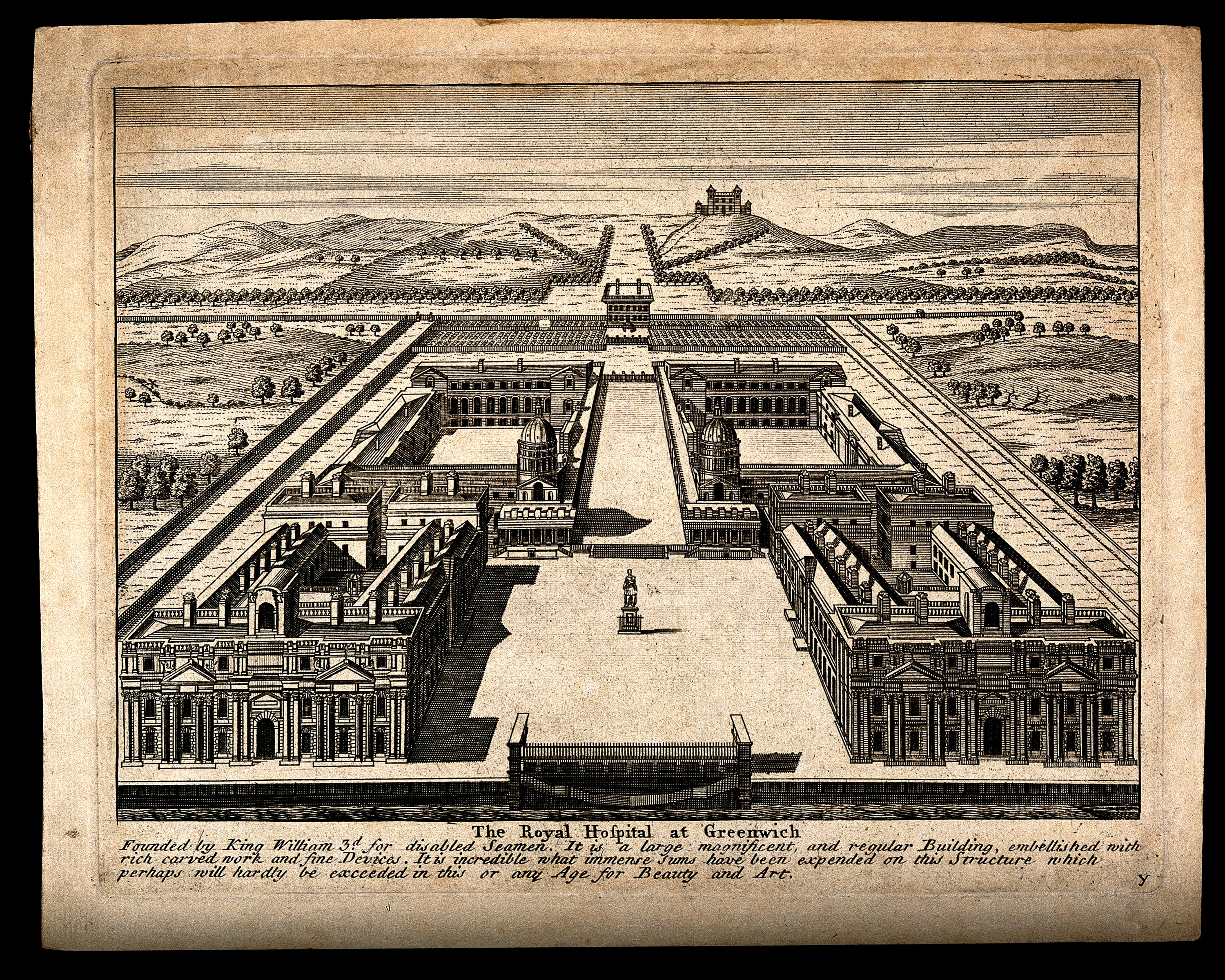
Royal Naval Hospital, Greenwich. Etching by B. Cole. Wellcome V0014667.jpg
 
Engraving by Benjamin Cole.
37.7 x 52.5 cms.
Image from The Welcome Library.


Royal Hospital Greenwich.
Engraving
James Caldwell (1739 - 1822).
Welcome Library.
 
 
Undated and so far anonymous engraving of the Royal Hospital, Greenwich
Clearly showing the statue by Rysbrack.
16.3 x 22.5 cms
Welcome Library.
 
Definitely my favourite engraving of the subject.
 
 
__________________________________________


For an extremely useful essay on the very important issue of coinage of Ireland in the mid 18th Century from which the following images save been lifted see -
 
 
I thoroughly recommend this website to anyone with even a slight interest in numismatics.


George II Irish Farthing.


George II Irish Halfpenny.
 
 
Half Crown of 1746.